

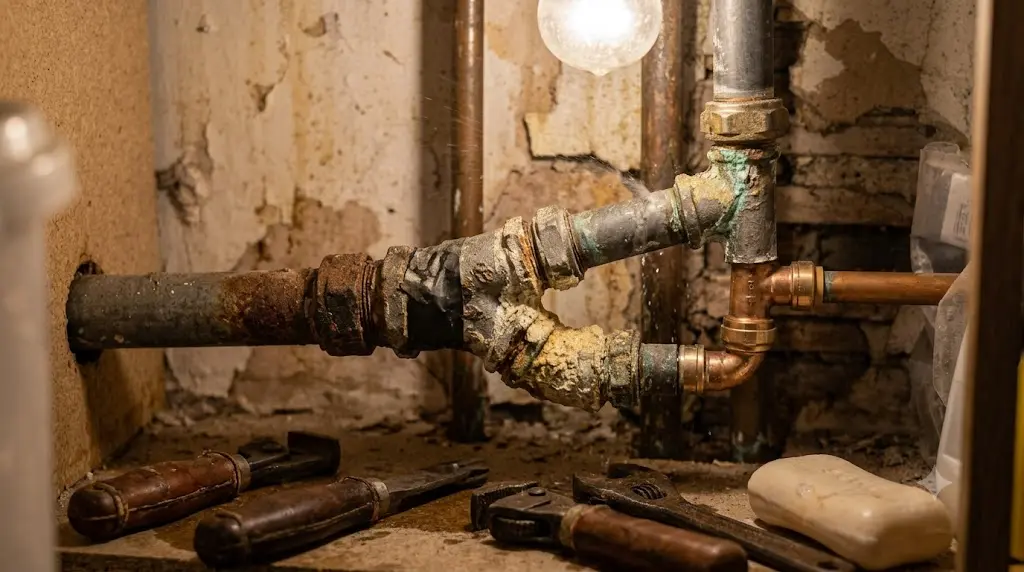
Older homes across Luton, from Victorian terraces in High Town to Edwardian bay fronted houses near Wardown Park and 1930s semis around Stopsley, hide a common weakness beneath their charm: ageing plumbing that was never built for modern demand. If you own or rent a period property in Luton, understanding these issues before they turn into emergencies can save you hundreds of pounds and a lot of stress.
Why Luton’s Older Housing Stock Faces Unique Plumbing Challenges
Luton grew rapidly during two building booms, one in the late Victorian era tied to the hat trade, and another in the interwar years as the town expanded around the car and aircraft industries. Many streets in areas like Biscot, Round Green and Bury Park still contain homes with their original pipework, sometimes patched and modified by several generations of owners rather than fully replaced. On top of that, Luton and the surrounding Bedfordshire area sit on a chalk aquifer, which means the local water supply is naturally hard. That combination of old materials and mineral rich water is exactly what accelerates the problems below.
Corroded and Outdated Pipework
Homes built before the 1970s in Luton often still contain galvanised steel pipework, and in some pre 1960s properties, lead supply pipes may still be present. Galvanised steel corrodes from the inside, gradually narrowing the pipe and releasing rust into the water supply. This shows up as discoloured or metallic tasting water, especially after the tap has not been used for a few hours. Lead pipes are a more serious concern, since they can allow lead to leach into drinking water over time. If your Luton home was built before 1970 and you are unsure what your supply pipe is made of, a plumber can identify it quickly, and a water test can confirm whether replacement is needed.
Limescale Buildup from Hard Water
Because Luton draws from a chalk fed aquifer, the water here is considerably harder than in many other parts of the country. Over decades, that mineral content builds up inside pipes, immersion heaters, boiler heat exchangers and shower heads. The result is often reduced water pressure, a boiler that struggles to heat efficiently, and white crusty deposits around taps and kettle elements. In older homes where pipe diameters were already narrow to begin with, limescale can choke water flow much faster than it would in a newer property. Power flushing a heating system and fitting a water softener are two solutions many Luton households use to slow this process down.
Low Water Pressure Throughout the Property
Weak flow in the shower or kitchen tap is one of the most common complaints in Luton’s older terraces and semis. It usually comes down to one of three causes: narrow original pipework that cannot keep up with modern usage, limescale narrowing the internal diameter further, or a hidden leak somewhere along the supply line that is quietly reducing pressure before water even reaches the fixture. Because so many period homes in Luton have had extensions, loft conversions or extra bathrooms added over the years, the original plumbing is frequently asked to serve far more outlets than it was ever designed for.
Aging Boilers and Inefficient Heating Systems
A lot of the housing stock around Luton town centre, Leagrave and Marsh Farm still relies on heating systems that are well past their most efficient years. Older boilers combined with hard water scale inside radiators and pipework often lead to cold spots on radiators, longer heat up times, and noisy banging or gurgling sounds known locally by plumbers as kettling. This noise is usually a sign that sludge and scale have built up inside the system. Left unaddressed, it forces the boiler to work harder, which pushes energy bills up and shortens the lifespan of the unit. A Gas Safe registered engineer can assess whether a power flush and servicing will fix the issue or whether the boiler itself needs replacing.
Hidden Leaks Behind Walls and Under Floors
Many Luton period homes have suspended timber floors and lath and plaster walls, which means pipework often runs in places that are difficult to inspect visually. A small leak can sit undetected for months, gradually causing damp patches, peeling paint, or a musty smell before any water actually appears. By the time a stain shows up on a ceiling, the leak has often been running for a while. Modern leak detection equipment allows a plumber to trace the source without having to lift entire floors or strip walls, which matters a great deal in a property where you want to preserve original features.
Outdated Stopcocks and Shut Off Valves
In many older Luton homes, the main stopcock is the original fitting, sometimes tucked under floorboards near the front door, hidden in a cupboard, or located outside in a small chamber that has since been paved over or built on. Individual shut off valves for sinks, toilets and appliances are often missing entirely in properties that have not been updated, which makes even a simple repair harder because the whole water supply has to be turned off. It is worth locating and testing your stopcock every few months. A seized valve during an actual emergency is far more stressful than a quick check now.
Blocked and Deteriorating Drains
Older drainage systems in Luton, particularly in Victorian terraces, tend to use narrower pipes than modern building standards allow, and decades of grease, debris and root intrusion from mature garden trees can slow drainage considerably. Warning signs include gurgling sounds, slow draining sinks, or bad smells near outside gullies. Regular drain clearance and the occasional camera inspection can catch a partial blockage before it becomes a full sewage backup.
Getting the Right Help for Your Luton Property
Older homes reward careful, experienced hands rather than quick fixes. A plumber who regularly works on period properties in Luton will know where stopcocks tend to hide, how hard water affects local systems, and when a repair is enough versus when a section of pipework genuinely needs replacing. If your home is showing any of the signs above, an inspection now is almost always cheaper than an emergency callout later, and it helps protect both your plumbing and the character of the property you love.