
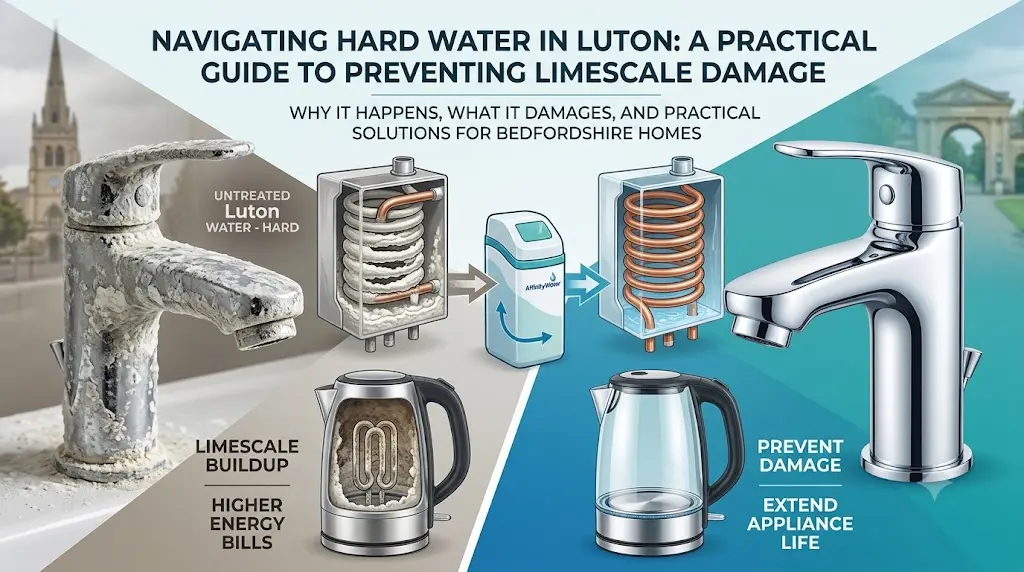
The best way to prevent limescale damage in Luton is to reduce the amount of calcium and magnesium that reaches your pipes and appliances, either by softening the water at the source or by removing scale build up before it hardens into a permanent deposit. Luton sits on a chalk aquifer, and homes here regularly receive water rated as “very hard,” often above 300 mg/l of calcium carbonate. That single fact explains almost everything else in this guide: more minerals in the water simply means more scale in your home, and a slightly different approach to prevention than someone living in a soft water region of the UK.
If you have just moved to Luton, or you have lived here for years and are only now noticing crusty taps and a kettle that takes longer to boil, this guide walks through why it happens, what it actually damages, and the practical steps that work best for local homes.
Why Luton Has Such Hard Water
Luton’s water supply comes largely from underground chalk sources managed by Affinity Water, including treatment works local to the town. As rain filters down through chalk and limestone rock, it picks up dissolved calcium and magnesium along the way. This is a natural process, not a fault in the supply, and it means the hardness level in Luton stays fairly constant throughout the year rather than fluctuating with the seasons.
Compared with cities on softer geology, such as those drawing from granite or moorland reservoirs in the north and west of Britain, Luton and much of Bedfordshire fall firmly into the “hard” to “very hard” category. That puts local homeowners in a similar position to residents of St Albans, Watford, and other towns supplied from the same chalk belt.
What Limescale Actually Does to Your Home
It is easy to think of limescale as a cosmetic problem, the chalky ring around a bath or the white crust on a showerhead. In reality, the visible mess is only the part you can see. Inside your plumbing, the same mineral deposit builds up gradually on every surface that hard water touches.
A few of the most common consequences in hard water homes include:
Reduced appliance lifespan. Kettles, washing machines, dishwashers, and combi boilers all heat water, and heating is exactly when calcium carbonate drops out of solution and clings to metal surfaces. Over months and years, this coating insulates heating elements, forcing them to work harder and wear out sooner.
Higher energy bills. A limescale layer acts like a blanket around a heating element. Even a thin coating can noticeably increase the energy needed to heat the same volume of water, so your boiler or immersion heater ends up costing more to run for the same result.
Reduced water pressure and flow. As scale narrows the internal diameter of pipes and showerheads, water has to squeeze through a smaller space. Many homeowners notice their shower gradually losing pressure over a year or two without realising limescale is the cause.
Damage to seals and fittings. Tap washers, valve seals, and shower cartridges can be affected as scale builds around moving parts, eventually leading to drips, leaks, and stiff or seized valves.
Corrosion of chrome and other finishes. In some cases, scale that is left to harden can pull away chrome plating when it is finally removed, leaving fittings pitted or discoloured underneath.
None of this happens overnight, which is exactly why it catches people out. The damage is gradual, so by the time a homeowner notices a real problem, such as a boiler breakdown or a washing machine that no longer heats properly, the limescale has usually been accumulating quietly for a long time.
The Main Prevention Methods for Hard Water Homes
There is no single fix that suits every household, since budget, the age of your plumbing, and how much water your home uses all play a part. The methods below are the ones plumbing professionals in hard water regions recommend most often, roughly in order of how comprehensive they are.
1. Whole House Water Softeners
A water softener is the most thorough solution for a town like Luton, where hardness levels sit well above the national average. These units typically work through ion exchange, swapping the calcium and magnesium ions in your water for sodium ions using resin beads inside the unit. The water leaving the softener is genuinely soft, which protects every appliance and pipe in the house rather than just one fixture.
The main trade off is upfront cost and the space needed to install a unit, along with occasional maintenance such as topping up salt. For homes with very high hardness readings, many owners find the reduction in appliance repairs and energy use pays this back over time.
2. Descaling and Cleaning Routines
Even with a softener, some scale exposure is unavoidable, particularly for taps and shower screens exposed to standing droplets. A simple, low cost habit that makes a real difference is drying surfaces after use rather than letting water evaporate on its own, since evaporation is exactly when minerals are left behind.
For removal, mild acids do most of the work. White vinegar, diluted and left to sit on affected areas before scrubbing, breaks down existing deposits without harming most fittings. Descaling solutions designed specifically for kettles, washing machines, and dishwashers should be used on a regular schedule rather than only when scale becomes visible.
3. Shower Filters and Point of Use Devices
For households not ready to commit to a full softener, an inline shower filter is a much cheaper starting point. These fit onto a standard shower hose and reduce hardness and chlorine at the point of use, which helps protect skin, hair, and the shower fitting itself, even though it does nothing for the rest of the plumbing system.
4. Physical and Electronic Conditioners
Electronic and magnetic water conditioners work differently to a softener. Rather than removing minerals, they alter how the minerals behave in the water, aiming to stop scale from clinging firmly to surfaces. Results vary depending on the product and the hardness level involved, so it is worth researching independent reviews rather than relying on marketing claims alone, particularly at hardness levels as high as those found around Luton.
5. Regular Appliance Maintenance
Draining and flushing a water heater once a year with a vinegar solution helps clear sediment before it hardens into a thicker layer. Similarly, running an empty washing machine cycle with a descaling product every few months keeps drums and heating elements clear, extending the working life of the appliance considerably.
Choosing the Right Approach for a Luton Home
Given that Luton’s water regularly tests above 300 mg/l, a hardness level that many guides classify as “very hard,” relying only on occasional cleaning is unlikely to be enough to fully protect a boiler or an expensive appliance long term. A combination approach tends to work best in practice: a whole house softener or conditioner to reduce the mineral load reaching your pipework, paired with a simple habit of drying surfaces and descaling smaller items like kettles on a monthly basis.
If you are unsure how hard your specific supply is, checking your postcode through your water provider gives an exact reading, since hardness can vary slightly between different zones of the same town.
When to Call a Plumber
Some signs point to damage that has already progressed beyond a DIY fix. These include a boiler that is noticeably noisier than before, a persistent drop in hot water pressure, visible white deposits inside a cold water tank, or leaks developing around taps that previously worked fine. A qualified local plumber can assess whether a softener would suit your plumbing setup, flush a system that already has built up scale, and check whether any fittings need replacing before the damage spreads further.
Frequently Asked Questions
Is Luton’s tap water safe to drink despite being hard?
Yes. Hardness relates to mineral content, not safety. Luton’s supply is treated and tested against UK drinking water standards, and hard water poses no health risk, it is simply more prone to causing limescale.
How quickly does limescale build up in a very hard water area?
In areas above roughly 300 mg/l, visible scale can appear on kettles and showerheads within a matter of weeks, and untreated appliances may need descaling on a monthly basis to stay efficient.
Does a water softener remove all limescale problems?
A softener addresses the root cause by removing the minerals before they reach your pipes, but existing scale already inside old pipework or appliances will not disappear on its own and may still need a separate descaling treatment.
Can limescale actually damage a boiler?
Yes. A layer of scale on a heat exchanger reduces efficiency and can lead to overheating, noisy operation, and, in more serious cases, early failure of the unit.
Is vinegar safe to use on all fittings?
Vinegar is generally safe on chrome and most standard fittings when diluted, but it should be used cautiously on natural stone, some finishes, and rubber seals, since prolonged acid exposure can wear these down over time.
If limescale has already caused visible damage to your taps, boiler, or appliances, getting a professional assessment sooner rather than later usually saves money on repairs down the line.