
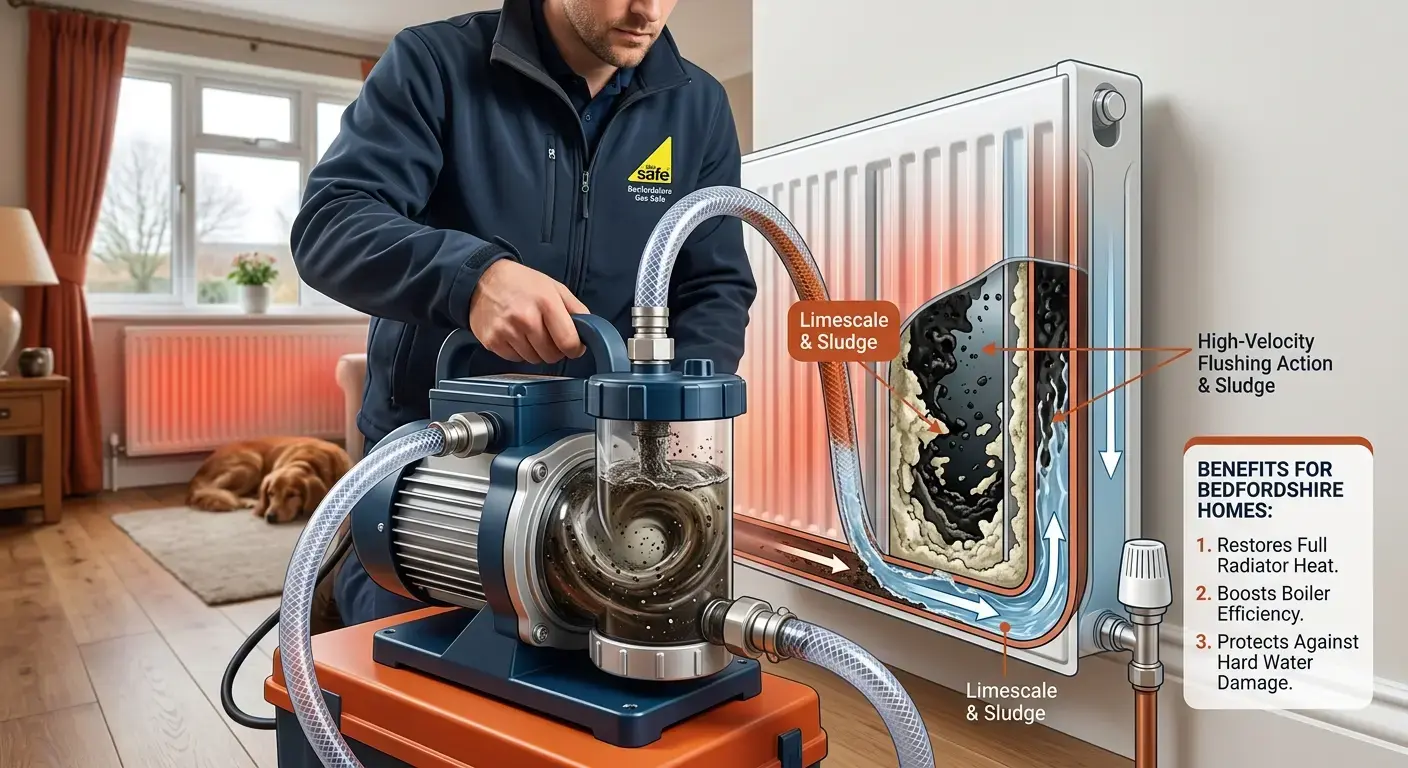
Yes, if your radiators are cold at the bottom, your boiler is noisier than it used to be, or your heating bills have crept up without explanation, a power flush is very likely overdue. Power flushing is a professional deep clean that pushes water and cleaning chemicals through your entire central heating system at high velocity, breaking up the rust, sludge, and limescale that quietly build up inside pipework and radiators over the years. For homeowners across Bedfordshire, where hard, chalky mains water speeds up limescale formation, this maintenance job matters more than most people realize.
This guide explains what power flushing involves, the warning signs to watch for, what it costs, and how to tell whether your Bedfordshire property genuinely needs one before winter sets in.
What Is Power Flushing, Exactly?
A power flush uses a specialist pump connected to your central heating system, usually at the boiler or a radiator, to force water through at a much higher flow rate than your boiler’s own circulation pump can manage. As the water moves through in both directions, it dislodges magnetite (the black, sludgy iron oxide that forms when steel and water react over time), along with limescale and general debris that has settled in bends, valves, and the bottom of radiators.
We add a cleaning chemical early in the process to help loosen this build-up, and once the system runs clear, we add an inhibitor to protect the pipework and radiators from corrosion going forward. It is a mechanical clean, not a repair, so it will not fix a broken valve or a leaking pump. What it does is restore the flow of water so your boiler and radiators can actually do their job properly again.

Why This Matters More in Bedfordshire
Much of Bedfordshire sits on chalk and limestone geology, which means the mains water supply across towns like Luton, Bedford, Dunstable, and Leighton Buzzard is classed as hard water. Hard water carries more dissolved calcium and magnesium than soft water, and when it is heated repeatedly inside a sealed central heating loop, it deposits limescale far faster than it would in a soft water region.
Combine that with an older housing stock, plenty of Victorian terraces and 1930s semis are still on their original pipework in parts of the county, and you get systems that accumulate sludge more quickly than average. If your boiler or radiators are more than five or six years past their last flush, and you live in a hard water postcode, the odds that a flush is overdue go up considerably.
Signs Your Central Heating Needs a Power Flush
You often cannot see the inside of a sealed heating system, so homeowners tend to notice the symptoms rather than the cause. Look out for the following.
Cold patches on radiators. If the top of a radiator feels warm but the bottom stays cold, sludge has likely settled and is blocking water flow at the base.
Radiators that need frequent bleeding. Trapped air that keeps returning, often paired with water that runs dark or black when you bleed a radiator, points to internal contamination.
Longer heat-up times. Rooms that used to warm quickly but now take much longer suggest reduced circulation somewhere in the loop.
A noisy boiler or banging pipes. Kettling, gurgling, or knocking sounds usually mean the pump is working harder to push water past a partial blockage.
Rising energy bills with no other explanation. A system fighting sludge has to work harder to reach the same temperature, and that inefficiency shows up on your gas bill.
Frequent boiler breakdowns. Debris circulating through the system can damage pumps, valves, and heat exchangers, so unexplained faults often trace back to dirty water.
If two or more of these sound familiar, it is worth having a Gas Safe registered engineer inspect your system before committing to a flush, since the same symptoms can occasionally point to a different fault entirely.
How the Process Works, Step by Step
A typical domestic power flush follows a similar pattern regardless of who carries it out.
- Assessment. The engineer checks the boiler type and the number of radiators and takes a water sample to gauge how contaminated the system already is.
- Connection. A power flushing pump is connected to the system, commonly at the boiler or via a radiator, and each radiator is isolated and flushed individually so debris is not simply pushed from one radiator into another.
- Chemical clean. A cleaning agent circulates through the pipework to break down sludge and limescale, sometimes helped along by an agitator tool on especially stubborn radiators.
- Flushing and testing. Clean mains water is run through until it comes out clear, and the engineer checks the pH balance to confirm the system will not be left acidic.
- Inhibitor dosing. A corrosion inhibitor is added at the end to slow future sludge formation and protect the boiler’s warranty terms; many manufacturers require proof of a clean system for the warranty to remain valid.
For an average three-bedroom home with around eight to ten radiators, the whole job typically takes somewhere between five and eight hours, and most engineers will finish it within a single day.
How Much Does a Power Flush Cost?
Prices vary with the number of radiators, how contaminated the system is, and whether a magnetic filter is fitted at the same time. As a rough guide for 2026, homeowners in the East of England, including Bedfordshire, can expect to pay somewhere in the region of £350 to £750 for a standard domestic property, with smaller flats at the lower end and larger homes with more radiators pushing the price higher. Adding a magnetic filter such as a MagnaClean or a Fernox TF1 unit afterwards is a sensible extra, since it catches new debris on an ongoing basis and reduces how often a full flush is needed in the future.
Always ask for a fixed-price quote in writing before work begins, and confirm which chemicals will be used; reputable engineers typically use branded products like Sentinel or Fernox rather than an unbranded generic cleaner.
Power Flush vs. Chemical Flush: What’s the Difference?
A chemical flush is a lighter touch option; cleaning chemicals are added and left to circulate at normal pump pressure for a period, then drained out. It is cheaper and quicker but far less effective against heavy sludge. A power flush uses much higher flow rates and dedicated equipment to physically dislodge debris that a chemical flush alone cannot shift. If your system shows several of the warning signs above, a chemical flush is unlikely to be enough on its own.
What Power Flushing Will Not Fix
It is worth being realistic about the limits of this service. A power flush will not repair a broken pump, mend a leaking valve, or resolve pressure loss caused by a leak elsewhere in the system. If your boiler is losing pressure regularly, that points to a separate fault that a flush cannot cure. A qualified engineer should always assess the system first rather than jumping straight to a flush, since fixing the wrong problem wastes both time and money.
Choosing an Engineer in Bedfordshire
Power flushing should only ever be carried out by a Gas Safe registered engineer, particularly where the boiler itself needs to be opened up or inspected as part of the job. Ask how many years of experience they have specifically with power flushing rather than general boiler servicing, request references or reviews from other local jobs, and confirm the quote includes chemicals, disposal of wastewater, and a post-flush inspection.
Frequently Asked Questions
How often should a central heating system be power flushed?
Most manufacturers and engineers recommend a flush every five to six years, though homes in hard water areas like Bedfordshire may need one sooner if warning signs appear earlier.
Is power flushing worth it before a new boiler installation?
Yes. Fitting a new boiler onto an old, sludgy system risks contaminating the new unit almost immediately, and many boiler warranties are conditional on the existing pipework being clean.
Can I power flush my own central heating system?
It is not recommended. The equipment, chemicals, and gas safety knowledge required mean this is a job for a qualified engineer; attempting it yourself risks damaging the boiler or invalidating its warranty.
Does power flushing damage old radiators?
It is very unlikely to cause damage when carried out correctly, though extremely old or already corroded radiators can occasionally spring a leak once heavy sludge that was plugging a small hole gets removed. A good engineer will flag this risk in advance if a radiator looks vulnerable.
How long does the process take?
Most homes are finished within a single working day, typically five to eight hours depending on the number of radiators and how contaminated the system is.