

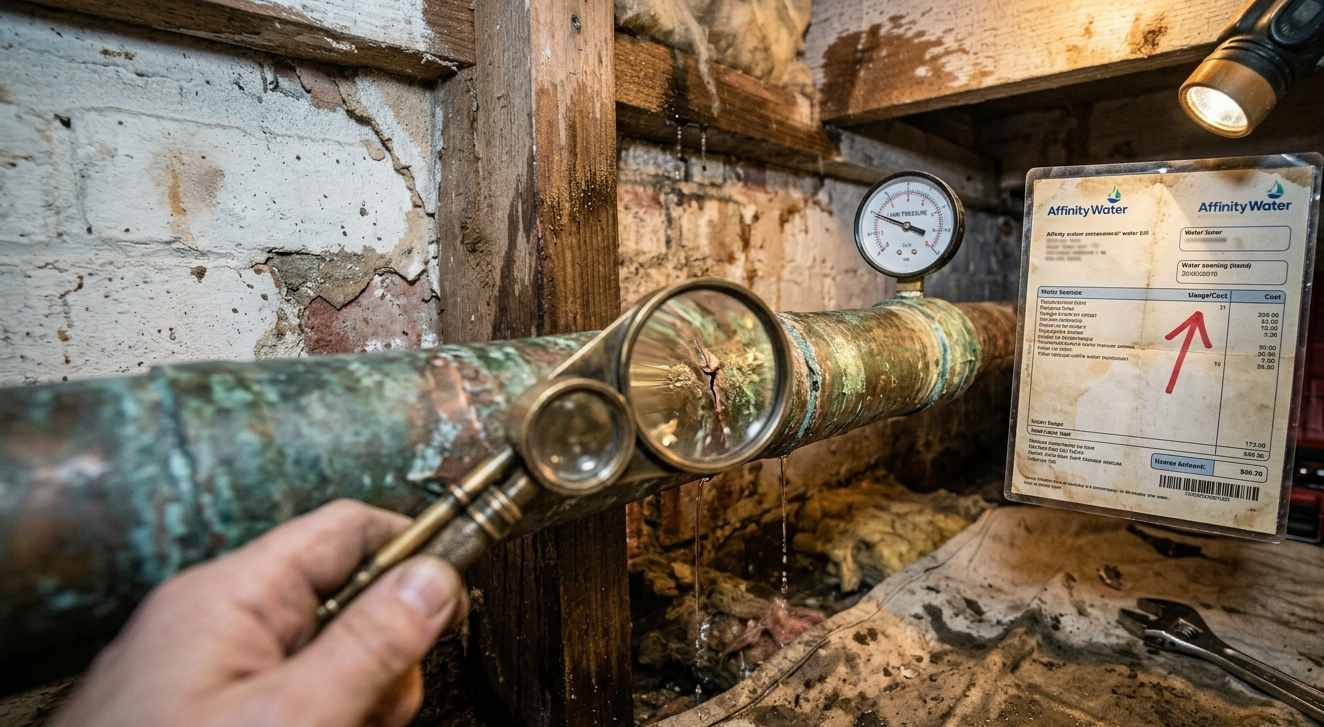
The short answer: Turn off your mains stopcock immediately, switch off your boiler and electrics if water is near any fittings, open all taps to drain the system, and call an emergency plumber in Luton. Every minute you delay, water is spreading into your walls, floors, and joists. Acting in the first five minutes can be the difference between a straightforward repair and a full-scale flood restoration job.
Why Burst Pipes Happen More Often Than You Think in Luton
Luton is not a city most people associate with plumbing disasters, but the reality is that properties across LU1, LU2, LU3, and LU4 face a specific combination of risks that make burst pipes a genuine and recurring problem.
Luton sits in a hard water zone. Anglian Water and Affinity Water both classify Bedfordshire and the surrounding areas as having moderately to very hard water. Over time, mineral deposits build up inside copper and steel pipes, restricting flow, increasing internal pressure, and weakening the pipe wall from the inside out. Most homeowners have no idea this is happening until something gives way.
Then there is the housing stock. Large parts of Luton, particularly around Bury Park, High Town, and the town centre, consist of Victorian and Edwardian terraced properties. These homes were built with lead or early copper pipework that has now been in the ground or behind walls for well over a century. Age alone is enough to cause failure. Add hard water deposits and the occasional cold snap, and you have a recipe for an unexpected flood.
Cold weather is the third factor. When temperatures drop below zero across Bedfordshire, the water sitting in exposed or uninsulated pipes, particularly in loft spaces, garages, and external walls, can freeze solid. As water turns to ice it expands, placing enormous outward pressure on the pipe. When it eventually thaws, or sometimes before it even does, the pipe splits or separates at a joint.
Understanding why pipes burst in the first place helps you respond faster and also helps you prevent a repeat occurrence once the immediate crisis is over.
How to Spot the Signs of a Burst Pipe Before It Becomes a Flood
A burst pipe does not always announce itself with a wall of water. In many Luton homes, especially those with pipes hidden inside cavity walls or under concrete floors, the first signs are subtle and easy to dismiss.
Watch out for a sudden and unexplained drop in water pressure at your taps. If you turn the kitchen tap on and get a trickle where you normally get a full flow, something is wrong somewhere in the supply line. Similarly, if you can hear water running or dripping inside a wall when every tap in the house is turned off, that is a near-certain sign of a hidden leak or a pipe that has already begun to fail.
Damp patches appearing on ceilings or walls, particularly after no rainfall, point strongly toward an internal pipe failure. Bubbling or lifting wallpaper is another giveaway. So is a water bill that has quietly crept up without any change in your household usage. Discoloured water with a rust or earthy smell often means corrosion has reached a critical point inside the pipe.
If you notice any of these warning signs, do not wait. Call a plumber before the situation escalates.
The Immediate Steps to Take When a Pipe Bursts in Your Luton Home
Step One: Find and Turn Off the Mains Stopcock
This is the single most important thing you can do, and you need to do it fast. Your mains stopcock is the valve that controls all water entering your property from the street supply. In most Luton homes, it is located under the kitchen sink, though in older properties it can be in a downstairs cupboard, a utility room, or even close to where the main supply pipe enters the building at floor level.
Turn the stopcock clockwise until it stops moving. This shuts off the water supply to the entire property. If the valve is stiff and difficult to turn, do not force it so hard that it breaks. Use both hands and apply steady, firm pressure. Once it is off, no more water can enter the property, which means the flooding stops at whatever water is already in the pipes.
Make a point of locating your stopcock before any emergency happens. Many homeowners in Luton discover during a burst pipe that they have never actually checked where it is, and the few minutes spent searching cost them thousands of pounds in water damage.
Step Two: Switch Off the Boiler and Immersion Heater
Once the water is off, turn your boiler off at the main controls. If you have an immersion heater, switch that off at the isolator switch as well. You do not want the boiler attempting to heat water that is no longer there, and you certainly do not want it circulating hot water through a compromised system.
Step Three: Cut the Electricity If Water Is Near Any Electrics
Water and electricity together are life-threatening. If the burst pipe is in a ceiling or wall that is close to light fittings, plug sockets, your consumer unit (fuse box), or any electrical appliances, switch off the electricity at the mains immediately. Do not enter a flooded room if there is any possibility that live electrical cables or outlets are submerged. Wait until you are certain the power is off.
In Luton’s older terraced housing stock, electrical wiring is often routed through the same wall cavities as pipework, which makes this risk higher than in newer builds. Treat any burst pipe near a wall with electrical fittings as a combined plumbing and electrical emergency.
Step Four: Open All Your Taps
With the stopcock shut, open every cold tap in the house and leave them running. This drains the residual water from the pipes so it comes out through the taps rather than through the burst. Flush every toilet two or three times as well. The faster you empty the system, the less water finds its way into your walls and floors.
Do not open hot taps until your boiler is off and the system has cooled slightly, as this could draw water back through the heating circuit.
Step Five: Contain the Water That Has Already Escaped
While the system drains, deal with the water that is already in your home. Place buckets under any dripping points. Use towels, old blankets, or any absorbent material you have to hand to stop water spreading from one room to another. If water is coming through a ceiling, the ceiling may be holding a significant volume above the plasterboard. Place a bucket beneath, then carefully make a small hole in the lowest visible bulge to release the water in a controlled way rather than waiting for the ceiling to collapse suddenly.
Move furniture, electronics, rugs, and any valuables to dry parts of the house as quickly as you safely can.
Step Six: Call an Emergency Plumber in Luton Straight Away
Once you have done everything above, pick up the phone and call a Gas Safe-registered, fully qualified emergency plumber. Do not attempt to repair the burst pipe yourself. Depending on the pipe material, its location, and the cause of the failure, what looks like a simple crack could be the symptom of a larger system issue. A professional plumber will assess the full extent of the damage, carry out a proper repair using the right materials, and check that no other areas of pipework are at risk.
ZM Plumbers operates a genuine 24/7 emergency service across all Luton postcodes, including LU1, LU2, LU3, LU4, LU5, and LU6. We aim to reach your property within one hour of your call.
Step Seven: Document Everything Before You Clean Up
Before you mop up or move anything, take photos and videos of every affected area. Walk through each room and record the damage to walls, ceilings, flooring, furniture, and any personal possessions. This documentation is essential for your home insurance claim. Note the time you discovered the burst, the time you turned off the stopcock, and the time you called the plumber. Insurers will want a timeline.
Do not throw away any damaged items until your insurer has reviewed them or until a loss adjuster has visited the property.
What Happens Next: The Repair Process Explained
Once the emergency plumber arrives, the work typically follows a clear sequence. First, they will locate the exact point of failure, which is not always where the water appears to be coming from. Water travels through structures and can emerge several metres from the actual burst. Acoustic leak detection equipment or thermal imaging cameras may be used to pinpoint hidden failures without unnecessary damage to walls or floors.
After locating the burst, the plumber will repair. This might involve replacing a section of copper or plastic pipe, re-joining a failed compression fitting, or replacing a section of older lead or galvanised steel pipework with modern materials. A pressure test is carried out after the repair to confirm that the system is sound before the water supply is restored.
In cases where a pipe has failed due to age or hard water corrosion, the plumber may recommend inspecting other vulnerable sections of the same pipework to prevent a repeat occurrence within weeks or months.
Contacting Your Home Insurer
Most standard UK home insurance policies include what insurers call escape of water cover, which is designed specifically for burst pipe damage. Cover typically extends to damage caused to your home’s structure, decoration, and contents, though the pipe itself may not always be covered under the same clause.
Contact your insurer as soon as the immediate emergency is under control. Most insurers run 24-hour claims lines. Give them the photos and timeline you have already collected. Ask specifically about emergency accommodation cover if your home is not habitable, temporary repair costs, and whether they have preferred contractors or require you to use an approved restoration company for drying out and reinstatement work.
Be aware that policies generally require you to take reasonable steps to prevent foreseeable damage. Leaving a property unheated in winter, or ignoring known leaks before a pipe fails, can complicate a claim. This is worth keeping in mind both now and in future.
How to Prevent a Burst Pipe in Your Luton Home
The best time to think about prevention is not during an emergency. Once your current crisis is resolved, take these steps to reduce the likelihood of it happening again.
Insulating exposed pipework, particularly in loft spaces, garages, and along external walls, is the most effective protection against winter bursting. Foam pipe lagging is inexpensive and straightforward to fit. Any pipe that runs through an area that does not receive household heating is vulnerable during a cold snap.
Servicing your boiler annually keeps the heating system running efficiently and helps a Gas Safe-registered engineer spot early signs of pressure problems that could stress your pipework. Hard water in Luton also makes fitting an inline magnetic filter worthwhile, as this captures the iron and limescale particles that accumulate in your system and eventually find their way into joints and valve seats.
If you plan to leave your Luton property empty during winter, whether going on holiday or managing a rental between tenants, keep the heating set to at least 12 degrees. A property left completely cold during a freeze is the most common cause of serious burst pipe damage, and it is also one of the most likely grounds for an insurer to reduce or reject a claim.
Consider fitting a smart water leak detector. These devices monitor your water usage in real time and can automatically shut off the supply or alert you via your phone if abnormal flow is detected. Fitted near your stopcock or beneath your kitchen sink, they provide an early warning system that no amount of insulation can replace.
When to Call ZM Plumbers in Luton
If you are dealing with a burst pipe right now anywhere across Luton or the surrounding areas of Dunstable, Harpenden, Houghton Regis, or Bedfordshire, call ZM Plumbers immediately on 07397 071028. Our engineers are Gas Safe registered, fully insured, and carry the tools and pipe fittings needed to handle the most common burst pipe repairs on a single visit.
We cover all LU postcodes and offer a genuine one-hour response target for emergency calls. There is no answering machine and no call centre, just a qualified local plumber who will pick up the phone and get to you as quickly as possible.