
Yes, hard water is quietly damaging your pipes if you live in Harpenden or St Albans, and the reason comes down to what is running through your taps every single day.
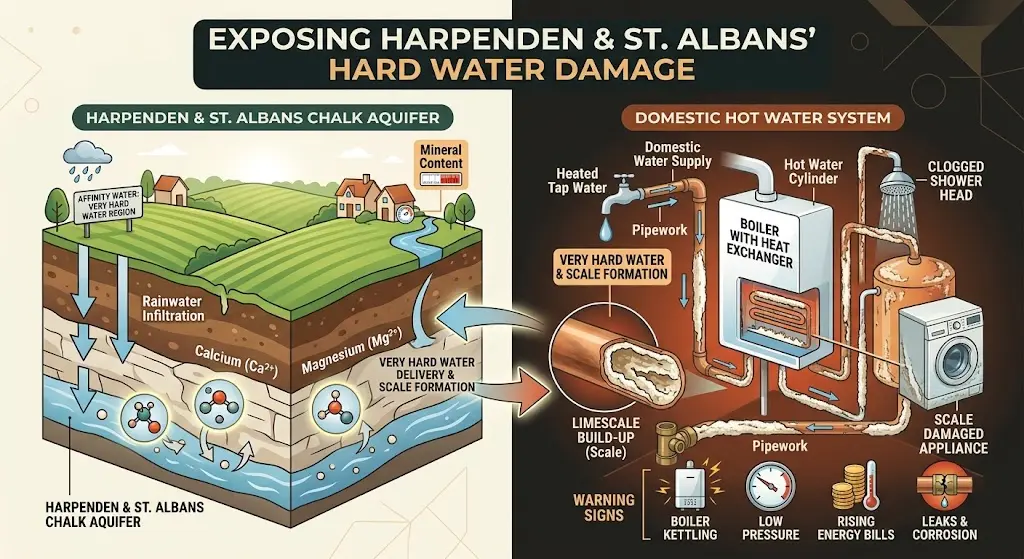
Both towns sit on a chalk aquifer supplied by Affinity Water, and that geology is exactly why homes here deal with some of the hardest water in the country. Independent water quality reports place local hardness anywhere from roughly 250 to over 330 mg/l of calcium carbonate, which puts Harpenden and St Albans firmly in the “very hard” category, well above the UK average. That mineral-rich water might be safe to drink, but it is slowly working against your plumbing system every time a tap runs.
Below is a plain English look at how hard water actually harms pipes in this area, what it costs homeowners over time, and what genuinely helps.
What Makes Harpenden and St. Albans Water So Hard?
The water reaching homes across AL5 and AL1 to AL4 postcodes is drawn from underground chalk and limestone sources. As water travels through this rock, it picks up dissolved calcium and magnesium. That process is natural and harmless to health, but it means every liter of tap water carries a heavy mineral load before it even reaches your stopcock.
When that water heats up in a boiler, cylinder, or combi system, the minerals cannot stay dissolved. They fall out of solution and form limescale, a chalky deposit that clings to the inside of pipework, valves, and heat exchangers.
How Limescale Builds Up Inside Your Pipes
Limescale does not appear overnight. It forms in thin layers, and each layer traps the next. Over months and years, this creates a narrowing effect similar to arteries clogging in the body.
- Pipe diameter gradually shrinks, restricting flow
- Rough limescale surfaces attract more mineral buildup faster than smooth copper or plastic
- Hot water pipework and cylinders scale up faster than cold mains
- Older Victorian and Edwardian properties common in central Harpenden and St Albans often have narrower original pipework, so they show symptoms sooner
The Real Damage Hard Water Causes
Reduced Water Pressure and Flow
As limescale narrows the internal bore of a pipe, less water can pass through it. Homeowners often notice showers losing pressure or taps taking longer to fill a kettle and assume it is a mains issue when it is actually scale buildup inside their own system.
Increased Strain on Boilers and Heating Systems
Limescale is a poor conductor of heat. When it coats the inside of a heat exchanger or hot water cylinder, the boiler has to work harder and burn more energy to reach the same temperature. This raises energy bills and shortens the working life of the appliance. Many local engineers report replacing heating elements and cylinders years earlier than expected due to hard water properties.
Pipe Corrosion and Premature Failure
Ironically, hard water can both protect and damage pipework at the same time. A thin limescale layer can shield copper pipe from corrosion, but uneven buildup creates weak points and blockages that raise internal pressure. Over time, this leads to pinhole leaks, joint failures, and cracked fittings, particularly at bends and valves where scale collects fastest.
Blocked Valves, Showerheads, and Fittings
Thermostatic mixing valves, ballcocks in cold water tanks, and showerheads all have narrow internal channels. These are usually the first parts of a plumbing system to fail in a hard water area, often within just a couple of years of installation if left untreated.
Shortened Lifespan of Appliances
Washing machines, dishwashers, and combi boilers all rely on internal pipework and heating elements that scale up in the same way as domestic pipes. Manufacturers frequently cite hard water as a leading cause of early appliance failure in areas like Hertfordshire.
Warning Signs Worth Watching For
- White or chalky residue around taps, showerheads, and kettle elements
- Reduced water pressure that develops gradually rather than suddenly
- Boiler making unusual banging or kettling noises during heating
- Rising energy bills without a change in usage habits
- Discolored water or small leaks appearing at pipe joints
What Actually Helps
Power Flushing
A power flush clears existing limescale and sludge from central heating pipework and radiators, restoring flow and efficiency without needing to replace pipes.
Water Softener Installation
A softener treats water at the point it enters your property, using ion exchange to remove calcium and magnesium before they ever reach your pipework. This is the most effective long-term solution for very hard water areas like Harpenden and St Albans, since it protects boilers, cylinders, and appliances rather than just the visible symptoms.
Regular Descaling and Maintenance
Scale reducers, in-line filters, and routine servicing of boilers and cylinders can slow down buildup, though they tend to manage the problem rather than remove it at the source.
Professional Leak Detection and Pipe Inspection
Because scale damage often develops out of sight, a proper inspection can catch weak joints or narrowing pipework before a leak becomes a burst pipe and a much larger repair bill.
Final Thought
Hard water is one of those problems that rarely announces itself until a boiler fails or a pipe bursts, yet it has usually been at work for years beforehand. Homes across Harpenden and St Albans are particularly exposed because of the local chalk geology, so a bit of prevention, whether that is a softener, a power flush, or a periodic pipework check, tends to be far cheaper than dealing with the aftermath.