

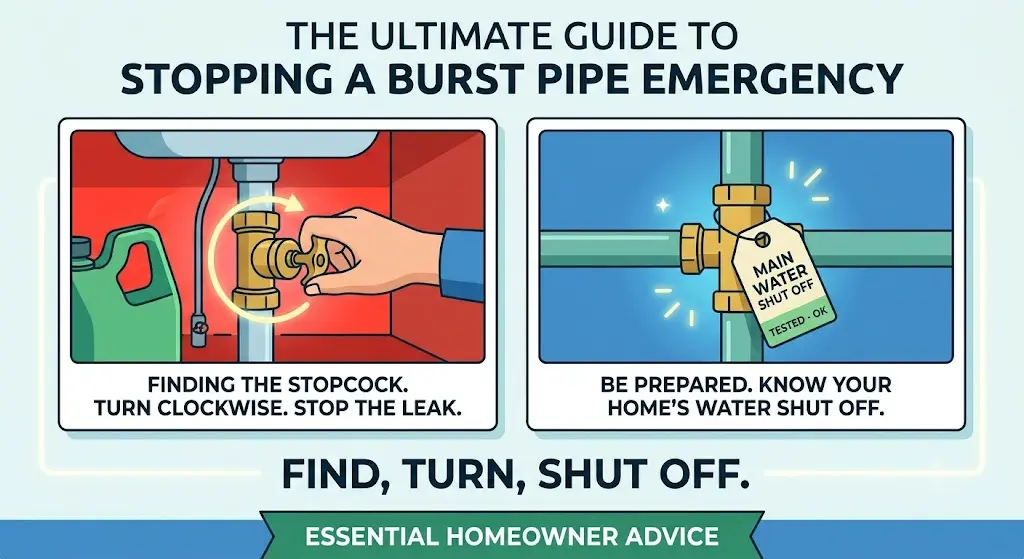
To shut off your water supply in an emergency, locate your internal stopcock, usually found under the kitchen sink, in an airing cupboard, or near where the water pipe enters your home, and turn it clockwise until it stops moving. This cuts off the cold water mains to your entire property within a minute or two and is the single fastest way to stop a burst pipe or major leak from flooding your home.
If you only remember one thing from this guide, remember that: find the stopcock, turn it clockwise, done. But knowing exactly where to look, what to do if it’s stuck, and what steps to take afterwards can be the difference between a minor inconvenience and a five figure repair bill. Here’s everything you need to know.
Why acting fast matters
A burst pipe can release hundreds of litres of water into your home within minutes. Beyond the obvious mess, standing water damages flooring, soaks into plasterboard, ruins electrics, and creates the perfect conditions for mould. The longer water keeps flowing, the more expensive and disruptive the repair becomes. Every second between noticing the leak and shutting the supply counts.
Step 1: Find your internal stopcock
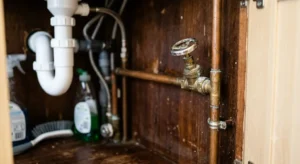
Your internal stopcock (sometimes called a stop valve or stop tap) controls the cold water supply to your entire property. It’s usually a small brass valve with a round or lever handle attached to a pipe.
Common locations include:
- Under the kitchen sink, tucked at the back of the cupboard
- In an airing cupboard or under the stairs
- In a downstairs toilet, particularly in flats or newer builds
- Near the front door, where the supply pipe first enters the house
- Under floorboards close to where the mains pipe comes up through the floor
If your kitchen has been extended or refitted over the years, don’t assume the stopcock has moved with it. It often stays close to the original pipe entry point.
Step 2: Turn it clockwise
Once you’ve found the stopcock, turn the handle clockwise (righty tighty) until it stops. Depending on the valve, this might take several full turns rather than a quarter turn. Don’t force it if it feels seized; forcing a stiff or corroded valve can snap the handle or crack the fitting, turning a leak into a much bigger problem.
If it’s stiff, a few drops of penetrating oil and a gentle back and forth motion can help loosen it. If it still won’t budge, move on to the next option rather than risk breaking it.
Step 3: Use the external stopcock if needed
Every property also has an external (or boundary) stopcock, usually located under a small metal or plastic cover set into the pavement or driveway, near the edge of your property. This is the water supplier’s valve rather than yours, and operating it usually needs a long stopcock key, which you can buy cheaply from any hardware shop.
Use the external stopcock if:
- You can’t locate the internal one quickly enough
- The internal valve is broken, seized, or missing
- The leak is on the pipe between the external and internal stopcocks
A quick note on responsibility: your water company owns and maintains the external stopcock, so in a genuine emergency you’re entitled to use it, but for repairs or replacement you’ll usually need to contact them directly.
Step 4: Isolate individual fixtures where possible
If the leak is coming from one appliance, such as a washing machine, dishwasher, or toilet, you may not need to shut off the whole house. Most modern kitchens and bathrooms fitted in the last couple of decades have small chrome isolation valves on the pipework feeding each tap, toilet cistern, and appliance. A quarter turn with a flat screwdriver, so the slot sits across the flow of the pipe, will cut the supply to just that fixture while the rest of your home keeps running water.
This is especially useful overnight or when you’re waiting on an emergency plumber, since it limits disruption while still stopping the leak.
Step 5: Drain the system and reduce pressure
Once the main supply is off, open your taps, starting with the lowest one in the house such as the kitchen tap, to drain any remaining water in the pipework and relieve pressure. This reduces the chance of further leaking from the affected pipe while you wait for repairs.
If the leak involves your hot water system, it’s also worth turning off your boiler or immersion heater at this point, both to prevent damage to the appliance and to avoid it firing up with no water passing through it.
What to do after the water is off
- Call a qualified, WRAS approved plumber to assess and repair the fault rather than attempting DIY fixes on burst or damaged pipework
- Photograph any damage for your home insurance claim before you start cleaning up
- Mop up standing water quickly to limit damage to flooring and skirting boards
- Keep the area ventilated to reduce the risk of mould developing over the following days
How to prepare before an emergency happens
The best time to find your stopcock is before you need it, not during a flood at 2am. Take five minutes today to:
- Locate both your internal and external stopcock
- Test that each one turns smoothly in both directions
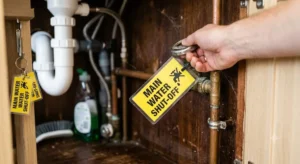
- Tag or label the valve clearly so anyone in the household can find it fast
- Keep a stopcock key somewhere accessible, such as a kitchen drawer, if you have an external valve
- Show everyone in your home, including older children, where the valve is and how to use it
If your stopcock is difficult to reach, seized, or leaking when tested, get it looked at by a professional before it becomes an emergency rather than during one.
Frequently asked questions
Where is the stopcock usually located in a UK home?
Most commonly under the kitchen sink, though it can also be found in an airing cupboard, under the stairs, or near where the water main enters the property.
Which way do you turn a stopcock to shut off water?
Clockwise to close it and stop the flow, anticlockwise to reopen it once repairs are complete.
What if I can’t find my internal stopcock?
Use the external stopcock instead, located under a cover near your property boundary, operated with a long stopcock key.
Is it my responsibility to fix a broken stopcock?
The internal stopcock is your responsibility as the homeowner. The external stopcock belongs to your water supplier, though you’re permitted to operate it in a genuine emergency.
How quickly should I shut off the water after discovering a leak?
Immediately. Even a few extra minutes of flow can mean significantly more water damage, so head straight for the stopcock rather than trying to find the source of the leak first.
Final thought
A plumbing emergency is stressful enough without also hunting for a valve you’ve never used before. Locate your stopcock today, test it, and make sure everyone at home knows where it is. If you ever run into a stiff valve, a hidden leak, or a fault you’re not comfortable handling yourself, our team is on hand for fast, reliable support whenever you need it.