
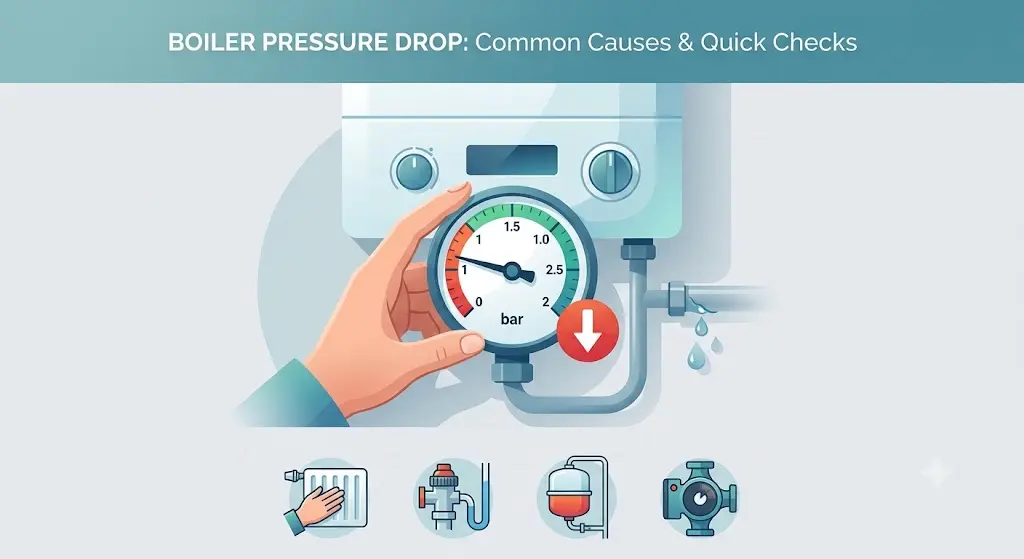
Boiler losing pressure is almost always caused by water escaping the sealed central heating system, whether through a small leak, a worn valve, trapped air, or a faulty expansion vessel. If your pressure gauge keeps dropping below 1 bar, the good news is that most causes are easy to diagnose once you know what to look for, and many are simple to fix without a full system replacement.
Below, we break down every common reason your boiler keeps losing pressure, how to tell them apart, and when it’s time to call a Gas Safe registered engineer rather than reaching for the filling loop again.
What Counts as Normal Boiler Pressure?
Most combi and system boilers are designed to run between 1 and 1.5 bar when the heating is cold, rising slightly to around 2 bar when the system heats up. If your gauge sits below 1 bar, the boiler is under pressured and may stop working properly or lock out completely. A quick glance at the gauge, usually a small dial near the bottom of the unit, tells you straight away whether you’re dealing with a genuine problem.
Occasional small dips are normal. What isn’t normal is pressure that keeps falling every few days, because that points to an underlying fault somewhere in the system.
Common Causes of Boiler Pressure Loss
1. A Leak Somewhere in the System
The single biggest cause of a boiler slowly losing pressure is water escaping from the sealed system. Leaks tend to show up at the weakest points first, which are usually radiator valves, pipe joints, or connections behind the boiler casing itself. Corrosion and general wear over the years can loosen these joints just enough to let water seep out gradually, so you may never see a dramatic puddle, just a slow, steady drop on the gauge.
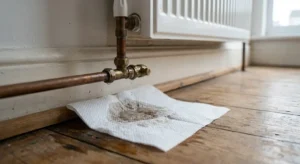
Check for damp patches on carpets, discoloured skirting boards, or a faint musty smell near radiators and pipework. Wipe any suspect pipe dry and place a piece of kitchen roll or a bowl underneath it overnight to see if moisture reappears.
2. Recently Bled Radiators
If you’ve bled a radiator to remove trapped air, it’s completely normal for the system pressure to fall afterwards. Bleeding releases a small amount of water along with the air, so the overall pressure in the loop drops. This is one of the easiest causes to fix yourself, simply top the system back up using the filling loop until the gauge reads the correct level.
3. A Faulty Pressure Relief Valve
The pressure relief valve exists purely as a safety feature, releasing water if the system pressure climbs too high. When this valve wears out or gets stuck, it can start discharging water even under normal conditions, causing pressure to drop steadily. A telltale sign is a small pipe outside your property, often called the discharge or overflow pipe, dripping or showing signs of limescale staining where water has been escaping.
4. A Damaged Expansion Vessel
Inside every sealed boiler system sits an expansion vessel, a small tank containing air on one side and water on the other, separated by a rubber diaphragm. Its job is to absorb the natural expansion of water as it heats up. If the diaphragm splits or the air charge is lost, the vessel can no longer cushion that expansion properly, and pressure will fluctuate or drop unexpectedly, particularly when the heating cycles on and off.
5. Airlocks in the Heating System
Trapped air anywhere in the pipework can create airlocks that interfere with the way pressure reads on the gauge and how efficiently your radiators heat up. You might notice cold spots at the top of radiators even after bleeding them, which usually points to air still circulating somewhere in the loop rather than a true water leak.
6. A Worn or Damaged Pump Seal
The circulator pump moves hot water around your home, and its seals can wear out over time. A failing pump seal often shows itself as a small, slow weep of water around the pump housing itself, gradually reducing overall system pressure. If the pump feels unusually hot, sounds noisy, or the surrounding area feels damp, this is worth having checked promptly.
7. Condensation Rather Than a Leak
Not every damp patch means a leak. Central heating pipework can sweat with condensation, especially in cold spots or poorly insulated areas, which can look identical to a slow leak at first glance. Drying the pipe thoroughly and monitoring it over 24 hours is the simplest way to rule this out before assuming the worst.
How to Check Your Boiler Pressure Gauge
Most modern boilers display pressure through either an analogue dial or a digital readout on the control panel. Many models also show an error code, such as a flashing symbol or a specific fault number, when pressure falls too low. Your boiler’s manual will list what each code means for your particular model, so it’s worth keeping a copy handy or searching for it online using your boiler’s make and model number.
Should You Just Keep Topping Up the Pressure?
Topping up pressure through the filling loop is a perfectly normal part of boiler ownership every so often. What isn’t normal is needing to do it every week or two. A properly sealed heating system should hold its pressure for months at a time. If you find yourself repressurising constantly, that’s a strong signal that something, whether a leak, a valve, or the expansion vessel, needs proper investigation rather than a quick top up.
When to Call a Professional
While bleeding a radiator or topping up pressure through the filling loop are safe DIY jobs, most of the causes above involve internal components that shouldn’t be opened up without the right training. A Gas Safe registered engineer can pressure test the system, check the expansion vessel’s air charge, inspect the pressure relief valve, and pinpoint hidden leaks using specialist equipment that isn’t available to homeowners.
If your boiler keeps losing pressure despite repeated top ups, or if you notice any burning smell, unusual noises, or a boiler that keeps cutting out, it’s time to get an engineer out rather than risk further damage.
Frequently Asked Questions
Why does my boiler lose pressure overnight?
This usually points to a leak somewhere in the system, since pressure naturally stays stable while the heating is off. A leaking valve or joint can cause a slow drop even without the heating running.
Is it dangerous if my boiler loses pressure?
Low pressure itself isn’t dangerous, but it will stop your boiler heating water properly and may cause it to lock out. Ignoring the underlying cause, however, can lead to further damage over time.
How often should I need to top up my boiler pressure?
Rarely. A healthy sealed system should hold pressure for several months without needing intervention. Frequent top ups mean there’s an underlying issue worth investigating.
Can I fix boiler pressure loss myself?
Bleeding radiators and topping up through the filling loop are safe to do yourself. Diagnosing leaks, valve faults, or expansion vessel problems is best left to a qualified engineer.
If your boiler pressure keeps dropping and you can’t find an obvious cause, our team of Gas Safe registered engineers can carry out a full pressure test and get to the root of the problem quickly, so your heating stays reliable through the colder months.