
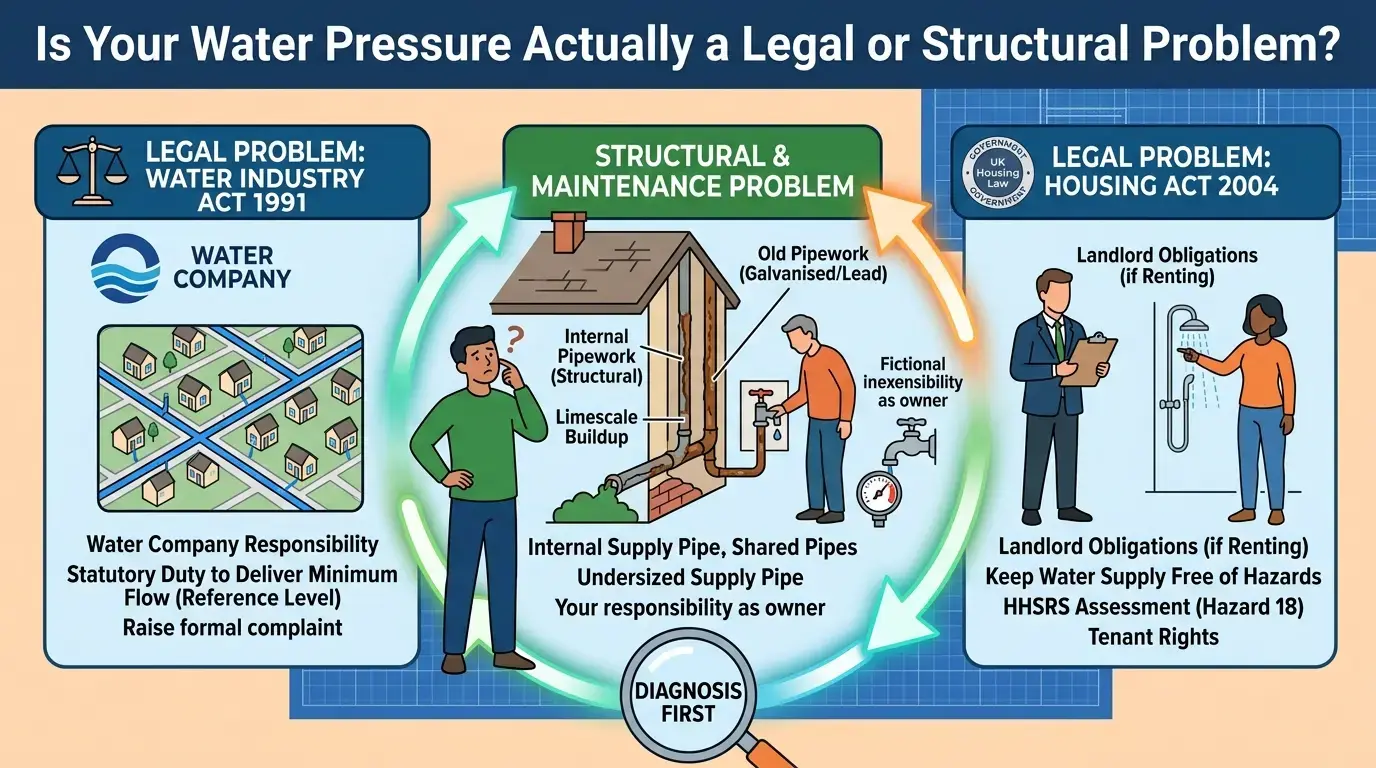
Is your water pressure actually a legal or structural problem? Often, yes. If your taps or shower have been running weak for weeks rather than minutes, the cause usually sits in one of three places: your internal plumbing (a structural issue you’re responsible for), your landlord’s obligations under UK housing law (a legal issue if you rent), or your water company’s statutory duty to deliver a minimum flow (a legal issue even if you own the property). Below is a practical way to work out which one you’re dealing with, and what to do about it.
Why “Just Call a Plumber” Isn’t Always the Right First Step
Weak water pressure feels like a plumbing problem, and often it is. But pressure complaints also sit at the intersection of three separate frameworks: the Water Industry Act 1991, which sets out what your water supplier legally owes you; the Housing Act 2004 and its Housing Health and Safety Rating System (HHSRS), which governs what a landlord must fix; and the physical condition of the pipework inside your walls, which is a structural and maintenance matter. Treating a legal problem as a DIY plumbing job (or vice versa) wastes time and money, so the diagnosis has to come first.
What Counts as “Low” Water Pressure in the UK
Before you can call something a problem, you need a benchmark.
Most UK properties run comfortably at 1 to 3 bar, which converts to roughly 14.5 to 43.5 PSI. Ofwat and the water companies work to a regulatory reference level of a flow of 9 litres per minute at 10 metres head on your side of the main stop tap, and this is the legal minimum they must maintain except during genuine, temporary events like burst mains or extreme demand.
If two properties share one supply pipe, that reference figure roughly doubles, since the same pipe has to serve both households.
You can check your own numbers with an inexpensive pressure gauge screwed onto an outside tap, or by asking your water company to test it, which they’re obliged to do on request. If you’re consistently below that reference level with no obvious internal cause, you have grounds to raise it formally, not just grumble about a slow shower.
The Diagnostic Framework: Legal, Landlord, or Structural?
Run through these three questions in order.
1. Is the Whole House Affected, or Just One Fixture?
If only your shower or one tap is weak, the fault is almost certainly local: a clogged aerator, a limescale crusted showerhead, or a partially shut isolation valve under a sink. That’s a five minute fix, not a legal matter.
If every outlet in the property is weak, the problem is upstream, either in your internal supply pipe, the shared pipework serving your building, or the water company’s main. This points toward a structural or legal issue rather than a fixture fault.
2. Do Your Neighbours Have the Same Problem?
Ask around, or check your water supplier’s live outage and low pressure map. If everyone on your street is affected, this is squarely a water company matter governed by their statutory duty to maintain supply, and you should raise a formal complaint with them rather than paying a plumber to chase a fault that isn’t in your home.
If you’re the only one affected, the fault sits somewhere between the property boundary and your taps, which is either your responsibility as owner or your landlord’s, depending on tenure.
3. Do You Own the Property or Rent It?
This is where the legal side sharpens considerably.
If you rent, your landlord has a statutory duty under the Housing Act 2004 to keep the water supply free of hazards. Water supply is formally assessed as Hazard 18 under HHSRS, and it covers the quality and adequacy of supply for washing, cooking, and sanitation, not just contamination. Persistently inadequate pressure can be scored as a Category 1 hazard if it’s severe enough to affect basic hygiene, which gives the local council’s environmental health team the power to compel repairs. Your tenancy agreement may also spell out plumbing responsibilities directly, so check it alongside the general law.
If you own the property, the internal pipework from your boundary stopcock onward is your responsibility, both financially and legally, in terms of keeping it safe and compliant with the Water Supply (Water Fittings) Regulations 1999. This is where “legal” shifts into “structural”: old pipework, undersized bore, or non compliant fittings aren’t just inconvenient, they can also fail a survey or hold up a sale.
The Structural Culprits Behind Chronic Low Pressure
Once you’ve ruled out a simple valve or fixture fault, these are the structural causes worth investigating, roughly in order of likelihood in UK housing stock.
- Galvanised steel or lead pipework. Common in properties built before the 1970s, these pipes corrode from the inside, narrowing the bore much like arterial plaque narrows a blood vessel. A pipe that’s lost even a third of its internal diameter can lose a very significant share of its flow capacity.
- Limescale buildup. In hard water regions, mineral deposits coat the inside of pipes, showerheads, and tap aerators over years, gradually strangling flow even in modern copper or plastic pipework.
- Gravity fed systems. Many older homes rely on a cold water tank in the loft rather than mains pressure. Pressure here depends on the height of the tank above the outlet, so upstairs bathrooms and top floor flats are structurally destined for weaker flow than ground floor kitchens, regardless of anything being “broken.”
- Undersized supply pipe. Extensions, loft conversions, and added bathrooms sometimes get plumbed into a supply pipe that was only ever sized for the original layout. The pipe isn’t faulty, it’s simply undersized for current demand.
- Faulty pressure reducing valve. Modern installations often include a PRV to protect appliances from high mains pressure. When these fail, they can throttle flow far below what the property should be getting.
- Shared supply pipes. Terraced houses, older conversions, and some flats share one pipe between two or more properties. If your neighbour’s internal plumbing is the bottleneck, your own perfectly sound pipework still delivers weak flow.
When Poor Pressure Becomes a Legal Compliance Issue, Not Just a Nuisance
There are a few situations where a plumbing survey stops being optional and starts being a compliance matter:
- Selling or remortgaging. A RICS survey or mortgage valuation can flag inadequate water supply as a defect, particularly if pipework is lead, galvanised, or clearly undersized. This can delay completion or trigger a retention on the mortgage until repairs are confirmed.
- Landlord compliance checks. Councils carrying out HHSRS inspections, or responding to a tenant complaint, will formally assess water supply adequacy. A landlord who ignores a Category 1 finding risks enforcement action, including Improvement Notices.
- New building work. Any extension, loft conversion, or added bathroom needs to comply with Building Regulations Part G, which sets standards for water efficiency and supply, so retrofitting new outlets onto old, undersized pipework can create a genuine regulatory problem, not just a comfort one.
- Fire safety. In HMOs and some blocks, water pressure feeds sprinkler or fire suppression systems, where inadequate pressure is a life safety issue, not a lifestyle one.
A Simple Diagnostic Checklist Before You Call Anyone
- Test pressure at an outside tap with a cheap gauge, and note the bar reading.
- Check whether one outlet, one room, or the whole property is affected.
- Confirm your internal stopcock (usually under the kitchen sink) and external boundary valve are fully open.
- Ask a neighbour whether they’re experiencing the same drop.
- Check your water supplier’s website for reported outages or works in your postcode.
- If you rent, review your tenancy agreement’s repair clauses and put any complaint to your landlord in writing.
- If nothing above explains it, arrange a professional inspection of your internal pipework, particularly if your property predates the 1970s.
When to Bring in a Professional
A plumber earns their fee once you’ve ruled out the obvious: a shut valve, a blocked showerhead, or a known local supply issue. From there, a proper pressure survey can confirm pipe material, bore size, and whether a booster pump, pipe replacement, or a straightforward limescale treatment is the right fix. For rented properties, a written report from a qualified plumber also becomes useful evidence if a landlord dispute needs to go to a council or a deposit adjudicator.
If you’re in Islamabad… actually, if you’re anywhere in the UK and unsure whether your low pressure is a five minute fix or a genuine structural issue, a proper inspection settles it far faster than guessing. ZM Plumbers carries out water pressure diagnostics that check the whole chain, from the boundary stopcock through to individual outlets, so you get a clear answer on whether the fix is a valve, a pipe, or a conversation with your landlord or water company.
Frequently Asked Questions
Is low water pressure a landlord’s legal responsibility?
Yes, if it affects the whole property and stems from pipework the landlord controls. Water supply adequacy is assessed under HHSRS Hazard 18, and persistent, severe cases can be treated as a Category 1 hazard requiring repair.
What water pressure is legally required in the UK?
Water companies must maintain a reference flow of at least 9 litres per minute at 10 metres head under normal demand, as set out under the Water Industry Act 1991. Below that consistently, without a temporary cause, you can raise a formal complaint.
Can low water pressure affect a house sale?
Yes. Surveyors can flag old, corroded, or undersized pipework as a defect, and mortgage lenders sometimes apply a retention until it’s addressed.
How do I know if low pressure is my problem or the water company’s?
Check whether neighbours on the same street are affected. If they are, it’s a supply side issue for the water company. If you’re the only one affected, the cause sits within your property boundary.
Can I claim compensation for prolonged low water pressure?
In some cases, yes. Water companies operate guaranteed service standards, and prolonged, unresolved low pressure that falls below the reference level can qualify for a compensation payment under their customer guarantee schemes. Check with your specific supplier for their current terms.